Showing posts with label flu vaccine. Show all posts

Tuesday, March 3, 2015

The Loss of a Champion: Laura Scott

By Karen Ernst

Laura Scott was the giant of public health you never heard of. She combined intelligence and generosity of spirit in a way that inspired trust. Because she was so good and so smart, when the sister of a teacher at my sons’ school succumbed to flu, I wanted to connect the family to Laura and to Families Fighting Flu. Laura gladly and quickly sent her business card and some materials for the family. I never even knew she was suffering through breast cancer.


Yesterday, when that breast cancer took Laura, we all lost something many never knew they had. We lost the champion of school-based flu clinics. We lost the champion of families who had been touched by influenza. We lost the mom who talked to college students about the need to take charge of their health by getting vaccinated against the flu.


Personally, I lost my flu vaccine mentor. The first time I spoke with Laura, we chatted about Jenny McCarthy’s gig on The View. And we talked about how we could inspire school children to get their flu vaccines through fun raffles. Over the years, I have appreciated her insight and advice as I worked to gain my footing with Voices for Vaccines. For many people in the vaccine world, Laura is a voice of reason and a sharp, thoughtful collaborator and colleague. She will be greatly missed.


You have perhaps never heard of Laura Scott, but you have been touched by her work. Please take a moment to honor her memory and her good work by donating in her memory to one of the two organizations about which she felt passionate:


Sunday, November 10, 2013

Science Illiteracy in the Daily Paper

As a former journalist, I find myself embarrassed by my profession more and more these days--and more and more grateful for the handful of news outlets that still adhere to journalistic ethics and a true understanding of "balance" in the discipline.

Today, November 10th, 2013, the Concord (NH) Monitor-News chose to accept an advertisement (and payment) from National Vaccine Information Center, the most notorious anti-vaccine group in the country, to run this embarrassment.

If you don't know why it's an embarrassment, that's okay--the unfortunate reality is that most people wouldn't, and that's what makes it so insidious. The whole "the flu shot gave me the flu" canard is pretty well entrenched in this country.

The flu shot does not give you the flu. It can't. It's physically impossible. Why? Because flu vaccines administered by needle are made with inactivated flu viruses (not infectious--dead) or no flu vaccine virus at all, which is how recombinant influenza vaccines are made.

That's what makes this advertisement from NVIC so laughable. It's like saying that the earth is warming because the American Girl Company is retiring "Molly, 1944." It's actually not laughable. It's maddening. It's maddening because I'm of the opinion that NVIC actually knows this is inaccurate information, but knows that it builds on an existing misconception that can bloom, for them, into general distrust of vaccines: their end-goal.

But I'm truly sickened by the editorial standards at the Concord Monitor-News. That it would allow such bald scientific illiteracy into their pages speaks volumes about the paper's approach to truth. And for a journalistic outlet, that is shameful. I've made my opinion known via Twitter this evening, and plan on following up with a letter tomorrow. I recommend you do the same. The Concord Monitor-News' Twitter handle is @ConMonitorNews.

If you'd like more information on the flu vaccine, check out the CDC's primer on the vaccine.

If you'd like to know why it's so crucial for children, in particular, to get the flu vaccine, check out this story in USA Today.

NOTE: I just noticed that an ad is playing on this site. I have no idea why and am working to sort it out. I apologize for this.

Friday, December 28, 2012

Madeleine and the Flu


Twelve little girls in two straight lines got the flu!

I was at a performance of Madeleine’s Christmas at a local theater the other day, my two children in tow. Madeleine’s Christmas is a charming book in the Madeleine series by Ludwig Bemelmans, written in 1956.  But as I watched the storyline unfold on stage, I found myself thinking like the MWV that I am, worrying about the eleven little girls suffering from influenza in an age when there was little to help them, besides the warm soup Madeleine (the only one unaffected) was able to serve them. I think my MWV radar was unusually sensitive that day, too, because my sixty-six-year-old father, who had received the flu vaccine this year, had just finished a bad bout with this year’s flu, and my children and I were struggling to kick a variety of different viruses as well.

Luckily, the eleven little girls—and Miss Clavel—all recovered in time to take a magic carpet ride around Paris, but the show did get me to thinking about how unusual this year’s flu season has been and why it’s so important that we see widespread vaccination, so that vulnerable people who might be more suspectible to the flu, even if they’ve been vaccinated (like my father), are better protected.

So I asked the folks at the CDC some of the questions that might be on your mind this flu season. The information below comes directly from CDC press releases, the CDC website, and communication with CDC representatives.

Why does the 2012-2013 flu season seem to be worse than previous flu seasons?

Flu seasons are unpredictable. The severity of influenza seasons can differ substantially from year to year. Over a period of 30 years, between 1976 and 2006, estimates of yearly flu-associated deaths in the United States range from a low of about 3,000 to a high of about 49,000 people during the most severe season. Each year in the United States on average more than 200,000 people may be hospitalized during a flu season. The 2009 H1N1 pandemic is an example of how unpredictable the flu can be. Click here for more information about the 2009 H1N1 pandemic.

The 2011-2012 season began late and was relatively mild compared with previous seasons (see “2011-2012 Flu Season Draws to a Close” for more information). Most of the viruses characterized so far this season have been H3N2 viruses; which are typically associated with more severe seasons.

Did the 2012-2013 flu season start “early”?

Significant increases in flu activity in the United States have occurred in the last two weeks (editor’s note: refers to late November, early December), indicating that an early flu season is upon us. Influenza-like-illness (ILI) activity levels in parts of the country are already higher than all of last season. 5 states are already reporting the highest level of activity possible. Click here for information from the CDC that discusses flu activity thus far. 

How effective is the flu vaccine?

The composition of the flu vaccine is reviewed each year. If needed, the vaccine is updated to protect against the three flu viruses that research indicates will be the most common during the upcoming season. New vaccine is manufactured every season. The 2012-2013 flu vaccine will protect against an influenza A (H1N1) virus, an influenza A (H3N2) virus and an influenza B virus.

Two factors play an important role in determining the likelihood that influenza vaccine will protect a person from influenza illness: 1) characteristics of the person being vaccinated (such as their age and health), and 2) the similarity or "match" between the influenza viruses in the vaccine and those spreading in the community.

In general, the flu vaccine works best among young healthy adults and older children. Lesser effects of flu vaccine are often found in studies of young children (e.g., those younger than 2 years of age) and older adults. Older people, who may have weaker immune systems, often have a lower protective immune response after influenza vaccination compared to younger, healthier persons. This can result in lower levels of vaccine effectiveness in these people. (This might explain why my father, who got the vaccine, still got the flu).

The good news is that most of the viruses characterized at CDC so far this season are well-matched to the vaccine viruses.

I want to make one note about the basic science of flu vaccines. Every once in a while, you might find an anti-vaccine website, like NaturalNews, make a comment about the flu vaccine. Last year, it was a story on its site that said that the reason a new flu vaccine had to be created every year is because the scientists “couldn’t get it right.” Most of you probably see scientific illiteracy in this statement, but in case it’s not clear, the flu virus changes each year, unlike most other vaccine-preventable diseases, and therefore a vaccine must “match” the predicted influenza viruses likely to spread in the community during the upcoming flu season in order to be effective.

You might also hear some people—even people in the world of public health—denigrating the current flu vaccines as ineffective. This shouldn’t be interpreted as a call to forgo the vaccine. Most of the time, when public health authorities, or leaders in the world of epidemiology, such as Michael Osterholm of the University of Minnesota, criticize the flu vaccine, they are advocating for a universal flu vaccine, or at least a better seasonal flu vaccine, both of which scientists are working on. 

I will take 60% protection over nothing any day, having lived through flu myself in years previous. And, without question, I would offer my children that same protection. I’m pretty sure that if that rug merchant in Madeleine’s Christmas had been peddling flu vaccines instead of magic carpets, the twelve little girls in two straight lines would have had a healthier Christmas, too.

Monday, October 15, 2012

"I'll Take Thimerosal"


Once upon a time, when I was still misapplying the precautionary principle, I got very hot and bothered around this time of year. I wanted my kids to get the flu shot, but I had heard so many scary things about thimerosal and how certain of the flu shots still contained it as a preservative that I would grow very anxious. I'd call around, making sure the clinic had FluMist (no thimerosal) or an otherwise thimerosal-free vaccine, and I'd feel very proud of myself for doing my "due diligence."  I even advocated on my now-defunct blog Science for Sale for "demanding" thimerosal-free flu vaccine at your pediatrician's office or clinic.


Now I say to nurses: "I'll take the thimerosal version."

My fabulous vaccinated children (old picture!)
Well, that's a bit of an exaggeration--not to mention a bit of plagiarism on my part (co-founder of Moms Who Vax, Karen Ernst, was the first person I'd ever heard say she asked a nurse for "the thimerosal one" just to make a point). But not by much. Last week, my three-year-old daughter had her well-child checkup. I wanted her to get her DTaP booster early, because of pertussis outbreaks in Minnesota and beyond and because signs are pointing to the current vaccine losing effectiveness sooner than expected. She'll get that booster later this week, but I was able to get her chicken pox booster and her flu shot at this appointment. When the nurse came into the room with the syringes, she looked at me and said, almost apologetically, "We don't have any thimerosal-free flu shots right now." To me, this was about as meaningful as hearing at Starbucks "I'm sorry, we're out of whipped cream today."

It was only later that night that I marveled at how far I'd come since those days at the Target clinic when I fretted over my older child's flu shot. I've come so far because I finally understand how vaccines actually work, how their components work in our body, and how leaving my child even a "little unimmunized" is a serious health risk--one I'm no longer willing to take. (Risk analytics is a subject I wish I'd studied up on earlier in my parenthood.)

For those who don't know, thimerosal is a preservative meant to keep the vaccines safe. If vaccines didn't have preservatives, then you'd really start seeing some "vaccine injuries." The CDC states that thimerosal is "added to vials of vaccine that contain more than one dose to prevent the growth of bacteria and fungi in the event that they get into the vaccine." If you've been following the news, you are probably keenly aware that fungi in injectable medicines is a bad thing--just ask the hundreds of meningitis victims trying to get well right now. However, thimerosal is in almost no childhood vaccines anymore--not MMR, not DTaP, not Hep B. The multi-dose vial of flu shot is really one of the only shots that might contain thimerosal.

When people express concern about thimerosal, they often use the overarching term "mercury." These same people (and I was one of them) almost never know that there is a huge difference between ethylmercury and methylmercury. Some of us (ahem, me) didn't even know there was a difference at all. Even though they have similar names, they are completely different materials. Worth repeating: completely different materials.

The one that people often think of when they hear the word "mercury" is methylmercury. This is the stuff that can be found in certain types of fish, formed in environments where mercury metal exists. High levels of methylmercury can be harmful to the human nervous system, and although federal standards try to control the level of mercury in foods and environments, the truth is we are all exposed to some methylmercury. It's this--methylmercury--that too many people think is part of the thimerosal preservative.

It's not.

The multi-vial dose of flu vaccine contains trace amounts of thimerosal, which contains ethylmercury, which does not "build up" in your body like methylmercury and is easily excreted. It is worth repeating that methylmercury and ethylmercury are different chemical compounds. As the WHO states, "The half-life of ethyl mercury is short (less than one week) compared to methyl mercury (1.5 months) making exposure to ethyl mercury in blood comparatively brief. Further, ethyl mercury is actively excreted via the gut unlike methyl mercury that accumulates in the body." If you need any reassurance or your own personal "chelation therapy" following a visit to the National Vaccine Information Center, take a look at this study from the New England Journal of Medicine that shows ethylmercury having no neurological effect on children who received vaccines with a thimerosal preservative. (There are two more.)

But this is mostly academic, because thimerosal was taken out of the vast majority of childhood vaccines a while ago at the request of the CDC. This wasn't because thimerosal is dangerous. Instead, it was done--against the protests of science-minded organizations--because the CDC feared the anti-vaccine movement had simply poisoned too many minds in their completely erroneous and harmful accusations of some sort of link between thimerosal and autism. The CDC removed thimerosal from vaccines as a preservative because they wanted parents to continue vaccinating and were afraid that the misinformation about it was too entrenched. It was the first time in recent history that science bowed to pseudo-science in this way.

So when I get my flu shot without even wondering if it contains thimerosal or not--when my child gets a flu shot that contains it, even though it's becoming harder and harder to find a thimerosal-containing flu shot--a little part of me feels like I'm standing up for science. Because I am.

Thursday, August 2, 2012

Moms Who Vax: Nicholas's Mom


Editor's Note: Nicholas' Mom is a Catholic work-at-home mom who lives in the Northeast with her husband and their six children.  


"Are any of them twins?"

And there it is again.  It's not an unreasonable question with so many children so closely spaced together, but every time it comes up I have to pause and loosen the lump in my throat, smile and say that no, none of the children standing with me are twins.  One of them, my littlest girl with the pigtails and impish grey eyes, should have been a twin though.  And she was a twin until Fall of 2009 when I caught H1N1 influenza.

We hadn't even been trying to get pregnant, so when those two pink lines showed up we felt pretty stunned.  However, my husband and I quickly wrapped our hearts around the fact that we would be welcoming our 5th child and were so excited to see him or her on ultrasound.  In the darkness of the ultrasound room at first I didn't know what I was looking at and wondered why there was something else in my uterus next to "the baby" until the tech pointed out very clearly "so, there is baby A and there is baby B."  I asked if she was sure.  I had to stop driving a few times on the way home to collect myself, muttering under my breath "one baby... and another baby.  Two babies?!?!!"  I hadn't expected to be pregnant at all and here I was, extra pregnant with a couple of stowaway twins.  I called my husband who quickly started calculating how we were going to afford a full size van.  I called my midwife, and a nurse friend who had two year old twins and started figuring out how to try to have the healthiest multiple pregnancy that I could have.  I wasn't sure how all of the logistics were going to work out, but we are a Catholic family and decided to place our trust in God and to walk by faith.  

For weeks I took belly photos, counted grams of protein, devoured any book on multiple pregnancies that I could and consulted with my doctor and my midwife about how to plan for pregnancy, birth and life with twins.  I felt amazing and was so excited about my babies. I cherished listening to baby A and baby B's heart beats, so distinct from each other, one much faster than the other.  Living in a house that would barely have accommodated one more baby, we started looking at finding a bigger home in our area and price checked on eBay to see what kind of car that would fit our family we could afford with our tax return that year.  

When the first cases of H1N1 started popping up in Mexico I barely noticed.  I thought the idea of "pandemic flu" sounded so overblown.  When my friend told me that natural immunity was better than the vaccine and there were miscarriages associated with the flu vaccine, I took what she said seriously the same way I trusted her about what size shirts I was going to be in by the end of my pregnancy.  I was afraid to get the vaccine.  Ultimately I wasn't sure whether I was more scared of the disease or of the terrible things my friend told me could happen if I got the vaccine, but I decided to trust my health care providers and signed up for the very first vaccine clinic for pregnant women in my county.  Beyond that I went about my daily life and just waited for the vaccine to become available in my area since there was such a severe shortage in our area.  I never thought that anything bad could or would happen to me.  I was in my mid 20s, ate a healthy diet with lots of vitamins, tried to lead a more natural lifestyle and I worked too hard to have a healthy pregnancy for anything to possibly go wrong.  I worried about how I might get pneumonia if I caught H1N1, but beyond that it never occurred to me that my babies could be at risk.

I was the first in my family to show symptoms.  At first I felt slightly off and then I spiked a fever that evening. Through the night I slept fitfully, slipping in and out of hallucinations and for the first time in my life truly afraid that something worse could happen to me from a virus than just being miserable for a few days or weeks.  My doctor saw me first thing in the morning while my husband and then our kids started showing symptoms, and immediately prescribed Tamiflu.  I realized how serious my condition was when my doctor gave me the "if you start turning blue, don't try to get to the hospital.  Call 911 immediately" discussion.  Within even a few hours of getting the Tamiflu on board I started feeling not exactly better but like I wasn't getting worse.  I was still weak and took time to recover fully, but I was certain that the worst of it was over.

But what bothered me in the weeks that followed was that I only heard one range of heart tones.  Before there had been two, even as recently as the day before I was sick.  They were still in two different places and I measured ahead enough that my midwife had no concerns, but I couldn't shake the feeling that something was off.  I put it down to being the normal jitters of a mother who had had previous pregnancy losses and trusted that everything was ok even if it didn't feel ok.  After all, the worst was over, so I waited for my 18 week ultrasound to find out whether my babies were boys, girls or one of each.  We brought all of our kids with us to see the babies on ultrasound, the day after Thanksgiving that year.  It was clear as soon as the tech's face changed from excitement to concern that something was very wrong.  She kept looking but finally had to tell us "right now I'm only seeing one baby."   With those words my heart sank through the floor.  I had children in the waiting room waiting excitedly to find out whether they were having brothers or sisters.  I had no idea how I was going to tell them what had happened.  The radiologist came immediately and confirmed what the technician had found and life would never be the same again.

Through so many phone calls to be made, emails, Facebook updates I felt numb and wondered what I had done wrong.   I took all of my vitamins, I was healthy and working so hard for a healthy pregnancy.  As much as I looked for things I should have done differently or better, I kept coming to the bewildering conclusion that there was nothing.  I had done everything right and my baby, my daughter's twin, still died anyways.  There was no rhyme or reason.  There was no missing piece of the puzzle that if I had just done that one missing thing, everything would have been ok.   The only thing that would have made a difference was the vaccine, and no amount of wishing was going to change the fact that there was a shortage and that I got exposed during that delay.  I am so thankful to still have my daughter, that she was able to survive, but loving her doesn't change the knowledge there is someone who isn't here who should have been.  

No one looks at my family and sees that empty space where the lost child we named Nicholas should be.  No outside observer sees the missing fingerpaintings, hears the missing voice in the crowd, or notices the muddy footprints that aren't left alongside his brothers and sisters.  But I see them.  I see them in my daughter's eyes and wonder whether Nicholas' would have been blue, brown or grey like hers are.  I see them at Thanksgiving when my beautiful little girl sits so proudly at the table and I know exactly how old Nicholas should be this year.  These are the invisible losses, these are the hidden pains that I will always carry because of what H1N1 did in my life.  And I will spend the rest of my life wondering what would have happened if I had been able to get the flu vaccine.

The question still comes up every so often even now that we have our 6th child:  are of my children twins?  No, and yet yes.  My daughter will never know her twin and I will never have that baby, that precious child in my arms.  But I carry him in my heart and in my life just the same.  I remember him with every vaccine that my children get as soon as they are eligible to receive it.  I remember him with every stranger or friend I help to research vaccines so that they can feel comfortable in the safety of immunizing their children.  I remember him with every step of immunization advocacy that I take, every time I share his brief life with others.  This is his legacy.  This is his life, and how I honor it by remaining Nicholas' mom.

Editor's note: Flu vaccine is strongly recommended for all pregnant women. It is safe for both mom and baby, and will provide the newborn added immunity through its first few months of life.


Monday, December 5, 2011

Their Loss, Your Decision

“We weren’t overly concerned.”

Jen Lastinger’s daughter, Emily, was suffering a bout of flu. The three-and-a-half-year-old who, her mother tells us, “loved princesses and Power Rangers,” had been back and forth to the pediatrician’s office, and each time, her parents were told that things were going as expected. That Emily would “get worse before she gets better.”
Emily Lastinger's Family

One morning, not long after her pediatirican’s visit, Jennifer left Emily watching a cartoon for a few moments while she tidied up the house. When she returned the bedroom, Emily was unconscious. Hours later, her brain activity ceased. She died from influenza.

Emily would have been saved by the flu vaccine. She hadn’t received it because at the time flu vaccine was recommended for certain segments of the population who were considered high-risk, like the elderly. Emily was not in the recommended group (thankfully, the recommendation has changed, thanks in part to the Lastinger family’s advocacy. These days everyone over the age of six months is recommended to get the vaccine).

It is Emily’s legacy, and proof that her death was not in vain, that writers and bloggers across the country are telling her story this week, National Influenza Vaccination Week. Since learning of her story, it is Emily’s face that I see every year around this time, when it comes time to vaccinate my children and myself against flu. She’s the reason why I am among the first in my circle of friends to have my children immunized.

In the last few years, many of my acquaintances have taken to denigrating the flu vaccine—either because they don’t think it works or because they don’t think the flu “is that bad.” Still others believe that “good nutrition” and “healthy eating” can keep the flu at bay. And there is, of course, that segment of parents who can’t abide by any vaccine because of misinformation about the way vaccines work, and leave their children, and the community, at grave risk.

So let’s talk today about some of the myths and facts about the flu vaccine. First, some facts. Flu causes 200,000 hospitalizations each year in the United States. That’s like having the entire city of Modesto, California, in the hospital over the course of a single flu season. Flu can cause up to 32,000 deaths in a season. The flu vaccine is one of the safest “medications” in human history (more on that later). But numbers can glaze the eyes. Even though every single one of those 200,000 hospitalizations caused 200,000 families grief, anxiety, and money, it's still hard to relate to on an individual level, which is understandable given the nature of statistics. For the human side of flu, please visit Families Fighting Flu.

On to the myths.

Myth: the flu vaccine is ineffective

Chelsea Oliver (Craft)
I’ve seen reports on various anti-vax websites or “natural news” websites that the flu vaccine just “doesn’t work”—they take as their proof the fact that the flu vaccine changes each year. (Although a person wouldn’t pass high school biology by making such a claim, it’s out there, and it has traction. )The truth is that it is a triumph of public health that a vaccine for flu can be produced at all. It’s a fickle, mutable virus, that changes from season to season. As a result, the vaccine has to be recreated each year in order to anticipate which influenza strains will be active during the coming winter season. Now you’ll often hear this trotted out as a reason not to get the flu vaccine—that it is anticipatory. For this logic to work a person would have to believe that 0% protection against a potentially deadly illness is equal to or better 50% protection. Let me get even more stark: this same logic suggests that 50% protection is not worth the drive/the trouble/the shot. I’m not willing to gamble like this with my children’s lives. I think in any other risk-reward analysis of harm to our children, every parent would go with 50% protection instead of 0% protection. Flu is a potentially deadly disease. We need to remember to see it that way.

Myth: the flu vaccine contains mercury

Well, first off, this is not true. Some multi-vial doses of flu vaccine contain thimerosal, but the vast majority of the vaccine—including those given at your pediatrician’s office—are thimerosal-free. The FluMist nasal spray is always thimerosal-free. That being said, I won’t bother getting into whether thimerosal in the levels present in any vaccines it was or is in (this multi-dose flu vaccine is the only childhood vaccine that contains the preservative) is worrisome (it’s not). As an aside, one of my favorite pro-vax moms likes to go into her clinic and ask for the "thimerosal-containing" flu shot, which they don't have, just to make a point. 

Myth: the flu isn’t that bad

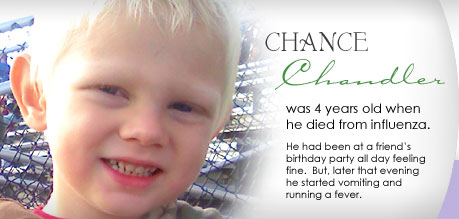
Tell anyone who says this to you to read Jen Lastinger’s story. Or the Chandler Family, whose four-year-old son, Chance, died. The Crafts, who lost their beautiful fifteen-year-old daughter Chelsea.  The Marottas, whose five-year-old son, Joseph, died from flu. The Lins. The Smiths. The McGowans. The Steins. The list at Families Fighting Flu goes on. And each one of these families is a family like yours. The loss was unimaginable. It is a slap in the face to any parent who has lost a child to flu to hear that disease described as “not that bad” or not worth vaccinating against. To me, as a parent, it’s these stories—stories these parents are willing to live through again and again as they advocate for flu awareness and vaccination—that get me in my car and to the doctor’s office for my shot and my children’s shots. If we are willing to entertain the decision whether or not to vaccinate our children against flu, we also must be willing to learn about these children. Otherwise we come by a decision not to vaccinate dishonestly.

Myth: the flu vaccine isn’t safe/its safety hasn’t been proven/it needs more testing

Given in the millions upon millions of doses around the world, the flu vaccine is among the most successful and safe vaccines ever devised. Dr. William Shafner, Chair of Preventive Medicine at Vanderbilt and President of National Foundation of Infectious Diseases tell us that the CDC, along with its sister public health organizations across the world, monitor the flu vaccine constantly. And although the FDA licenses a new variant of the vaccine every year, each vaccine comes to us with the basic structure of the vaccine that has that extraordinarily safe record. It honestly doesn't get any safer than this vaccine.

Myth: You can get the flu from the shot

This one’s easy. Nope. Not possible. There’s a chance you may feel achy and sneezy, but that’s not flu. It’s the immune response kicking in. It means your existing immune system wasn't up to snuff and it is now kicking into high gear. It means it is working.

At the end of the day, the decision comes down to whether you think your life is worth the flu shot. I know Emily Lastinger's was. I know Chelsea Oliver (Craft)'s was. I know Chance Chandler's was. I know every single child who has died from influenza's life was worth getting the flu vaccine, and it's a tragedy that in so many of these cases, circumstances prevented them from getting the vaccine. Whether it was outdated immunization guidelines, a snowstorm, a lack of vaccine at the clinic, or misunderstanding about the fact that you need to be vaccinated each year, the bottom line is that chances are these children would be here today if they had been vaccinated. And that's why their families fight, and will continue to fight every day of their lives, to make sure you never have to suffer like they did. It's your decision.

A special note to pregnant women: it is critical that you get your flu vaccine this season. You are as vulnerable to serious complications from flu as are the elderly. More, if you immunize, you pass on some of that protection to your baby, who will come into this world absolutely helpless against the flu. And with more and more people choosing not to protect themselves (and the community) against flu, you need to do all you can to keep that baby safe.

Friday, November 11, 2011

Moms Who Vax: Dr. Kate O'Brien's Story


Editor's Note: To mark World Pneumonia Day, Moms Who Vax, along with a number of other blogs, will run this commentary by pediatrician Kate O'Brien from Johns Hopkins on her experience with her own child's bout of pneumonia. 

By Dr. Kate O'Brien

I’m a pediatrician, an infectious disease pediatrician at that.  We’re supposed to know what to do when a baby has pneumonia---apparently that’s not always true.  I’ve treated hundreds of such cases --- but this time was different.   When it’s your own infant none of that experience matters.  Jack looked at me with what seemed like panic in his eyes.  Coughing, crying, breathing fast, sleeping in fits and spurts.  Babies aren’t supposed to breath that fast.  He lay beside me in bed. It was the day before Christmas and I just kept telling myself that we’d be better soon---apparently that’s not true either.    We both had influenza, I’m sure of that.  If you’ve had it you’ll know what I mean---I felt like hell, exhausted, muscle aches, every time I coughed it felt like sandpaper scraping over my trachea.  But since I’m an infectious disease doc, of course we were vaccinated!---well, apparently that wasn’t true this year.  I had every intention of getting that done weeks earlier, but life got in the way.

The middle of the night always makes things worse, or at least things seem worse.  So, we became ‘that family’, calling our neighbors in the middle of the night to care for our two-year old while we drove to the hospital with Jack.  So many times I was that doctor we were about to meet in the emergency room, scratching my head wondering, “Why did they wait the whole day at home and decide to finally come in at 2 in the morning?”  Well, now I knew.  Sometimes it doesn’t get better.  He had pneumonia on the chest x-ray and needed antibiotics.  

Every day, of every year, millions of children get pneumonia and struggle to breath; more than a million of them don’t get the treatment they need and die.  

Every day of every year something unimaginable to the mothers we are, happens to mothers we don’t know, over 90% of them living in poor countries in Africa and Asia ---their child dies in front of their eyes from pneumonia.  It’s senseless.   It’s inhuman. Vaccines against the biggest pneumonia causing bacteria, Hib and pneumococcus, along with other simple strategies can prevent these deaths.   

So, this year on World Pneumonia Day, look at your kids and remember to get them vaccinated, remember to get yourself vaccinated and remember that not every mother is so lucky….yet.  The GAVI Alliance is helping give those mothers the same opportunity for their kids, faster than ever before for any vaccine.  At a time when the world seems to be more complicated than ever, this seems like a pretty sensible thing to do.

Dr. Kate O’Brien, pediatrician, epidemiologist, Deputy Director of the International Vaccine Access Center (IVAC), Johns Hopkins Bloomberg School of Public Health, USA,
Winner of the 2011 US Presidential Early Career Award for Scientists and Engineers