Monday, January 30, 2012

Know a Fabulous Pro-Vax Parent or Provider?

We're putting the call out. The CDC wants to recognize the efforts of parents, health care professionals (Nurses, pediatricians, other physicians, medical assistants, etc), immunization advocates, and other fearless pro-vax champions, with their CDC Childhood Immunization Champion Award.

This is a new annual award that recognizes individuals doing exceptional work in the area of childhood immunization. This is not easy work, especially on the front lines. To get into this line of work is to invite heaps of abuse from anti-vaxxers, but the rewards are so great: healthy kids, happy parents, and safe and healthy communities.

Do you know anyone who helped reassure you about the safety of vaccines? A pediatrician who took the time to listen to your concerns and then gently but firmly tell you vaccines are safe for your child--and why? What about another parent who does work in the community? 

Here's the cool part--each of the fifty states, and the District of Columbia, get to select a CDC Immunization Champion. Awardees are recognized at both the local and the national level during National Infant Immunization Week, April 21-28th, 2012. So no matter where you're reading this, you can submit someone for nomination.
You can find the nomination forms and more information about the award at www.cdc.gov/vaccines/events/niiw/champions/childhood.html.

Nominations are due February 10th, 2012. If you live in Minnesota, you can send completed nominations to:

Andrea Ahneman
Immunization, TB & International Health
Minnesota Department of Health
P.O. Box 64975
St. Paul, MN 55164

Thursday, January 19, 2012

Why No Comments?

I've been meaning to write this post for a while, as we get e-mails from time to time asking why we don't have comments enabled on our website (some anti-vaxxers, characteristically not paying attention to details, gleefully assume lack of comments equals lack of interest in the website). The decision not to allow comments on the blog did not come easy. On one hand, open comments can often lead to healthy debate. 

I was not convinced, however, that in our case, the debate would be healthy. Instead, I feared our comments section would begin to look like a lot of blogs on the topic: a barrage of misinformation and downright falsehoods directed toward new and expecting parents in the hope that they will be scared out of vaccinating. Anyone speaking up for vaccines often finds herself under attack, even her love for her child questioned (happened to my sister). I even find there is a distinct level of desperation in these comments, as the hyperbole and vitriol grow stronger as the anti-vax movement grows weaker. I didn't want to be a place where that hyperbole and vitriol was on display.


In fact, as it becomes more and more clear in the scientific community--and in the media, thank God--that anti-vax claims of the harms of vaccine are utterly without merit, they have lost a great deal of access to new and expecting parents. No longer do new parents see anti-vaccine activists pitted against epidemiologists, pediatricians, and infectious disease specialists on morning shows. Rarely do you see these anti-vaccine activists quoted in newspaper articles. What they have left are their blogs and websites--and the comments sections on others' blogs and websites.


I remember vividly the late nights I spent, as an anxious new parent, scrolling through comments on articles about immunization, and growing more and more fearful the more and more "information" I read from anti-vaccine activists and mothers who chose "cod liver oil" over giving their child the DTaP for whooping cough. It took a lot more work, and some bad decisions about immunizations on my part, to realize I'd been duped. There is no law that says blog comments have to be truthful. In fact, a study in Science has found that online comments on science blogs, like ours, have a tendency to lower people's scientific understanding. 


I absolutely respect the decision of some of my favorite and most admired blogs and websites to keep comments enabled, and I fully support their reasoning for doing this. However, on this site, I have chosen not to enable comments from either pro-vaccine parents or anti-vaccine parents because I refuse to allow misinformation anywhere on the site--and the amount of time comment moderation would take to honor this is beyond my current capabilities. 

Another reason I choose not to enable comments is because the majority of the stories here are written by parents--parents who have chosen to talk about a health care decision they've made. They don't deserve vitriolic comments hurled toward them in a public forum (and I know because I get the e-mails these parents would've, had the commenters gotten ahold of their e-mail addresses or been able to comment on the stories). 


The media has often been accused, in covering the immunization debate, of employing false equivalency, something they have also been accused of doing in the climate change debate. That concept describes the way journalists (and others) mistake fairness and balance with equivalence. An example I use a lot is the Bigfoot Defense. If a news outlet were to do a story on species thought extinct but later found extant, and have on the panel a biologist, a rainforest activist, and E.O. Wilson, would it make sense to also have a person who knew a lot about Bigfoot? That's exactly what the media has done--except in the case of vaccines, this false equivalency has caused a great deal of harm in the form of dropping immunization rates.  You will not see a forum here for false equivalency, which is why the comments are closed. 

Some anti-vax blogs or commenters on other sites try to paint our decision as being about a lack of "courage" or some desire to create an echo chamber. If you've read this far, you know that courage is not something any of the moms who share their stories here lack. Time for sorting through scientifically challenged comments from people determined to keep you from vaccinating your child and protecting the vulnerable people in your community is. And as far as an echo chamber, my goal in life is to turn this vaccine debate become an echo chamber; the only voices I want to hear coming back at me when it comes to whether or not to vaccinate are ones saying: YES! That is nothing I'd ever apologize for, because vaccines save lives.

Saturday, January 14, 2012

"Intentionally Unvaccinated"

I came across a story on the Parents Who Protect blog that sent a chill down my spine. It was about a Hib meningitis outbreak here in Minnesota in 2009, which killed an infant and sickened four others. Hib is short for Haemophilus influenza type B. It's one of the basic childhood vaccinations. 
It's a terrible disease, and it's an unbearable story. But there's something about this story that makes it even more unbearable. The child who died, and two who were hospitalized, were intentionally unvaccinated. Parents of two of these children objected to vaccines; the parents of the third had delayed the vaccine until the child would be five years old. The news reports do not tell us who is who, and it really doesn't matter. The story made my heart bleed. I think about what it must feel like to be in those parents' shoes today and can only be in that place for moments. I don't wish this kind of grief on anyone. "We had a death from a child who was unvaccinated," Kristen Ehresmann, RN, MPH, of the Minnesota Department of Health said.  "We want to encourage parents who have delayed or refused vaccination to reconsider." 
It was stories like these--true stories--that transformed me from a vaccine-hesitant parent to one who is pro-vax. The true weight of my decision making process was laid bare, and I had to reexamine why I had come to my conclusions, what resources I'd consulted, and whether I was operating on fact or fear. We make these decisions for our children, because they can't; and we owe it to ourselves to base those decisions on the facts. I didn't want to be in the position of these heartbroken parents, wondering if I should have done things differently.  


If you are looking for more reassurance that the anti-vax claims are without merit, please consider reading Seth Mnookin's piece in The Huffington Post that ran recently

If you're coming from Australia's "Bubhub" forum...

I typically do not do this because it usually applies to just a handful of my readers, but I have noticed several readers coming to Moms Who Vax from a forum thread on Bubhub in which a parent posted "Vaccine Information" links, nearly all of them anti-vax save mine (kudos to her for at least including our site). I have a message for the parents who have reached this site in this way. A brief glance through the "vaccine information" links the well-meaning parent posted shows almost no science-based websites. Even "Vaccine Information Center" is an anti-vax website.

A few months ago I posted with a breakdown of five of the most common anti-vax websites masquerading as clearinghouses for vaccine information. You can read that link here. Here is another link worth looking at as well, if you feel any misgivings about the completed exploded idea about vaccines and autism being connected in some way.  I feel moved to post about this because I fear new and expecting parents reading that parent's post and looking at the links for "vaccine information" will be absolutely terrified--not to mention terribly mislead. I urge all parents to use science as their guiding principle when making life or death decisions about their child's health. And vaccine-preventable diseases are, in fact, a life or death decision. Are you willing, as a new parent, to leave your child open to great suffering and possibly even death from a disease that can be prevented by a vaccine because of rumors that vaccines may contain "toxins"--rumors that have, again and again, been proven by disinterested science to be false? This was the question I asked myself when I was researching the vaccine question, and posed this way, it was easy to answer.

Please take a look at my post about "vaccine information" websites.

Friday, January 13, 2012

Anti-Vax Legislation, Businesses, and Comment Threads: Moms Who Vax Newsletter #2

Whenever I send out a Moms Who Vax newsletter, I try to post it here as well. If you'd like to be added to the Moms Who Vax mailing list, contact us at momswhovax AT gmail.com

Anti-Vax Legislators--and How Pro-Vax Parents Can Play a Role in Stopping Them
Unfortunately, the Minnesota State Legislature has a handful of vocal anti-vaxxers in its ranks, including Rep. Mary Franson (R-11B), who represents folks in Todd and Douglas counties. From time to time these legislators try to tamper with state immunization statutes, and sometimes have been successful in seemingly small ways, like making sure information about how to opt-out from vaccines is in the same font as all other information on immunization paperwork. But during the Minnesota State Legislature's recess, Mary Franson introduced a bill that would make the notarization of the conscientious objection opt-out in Minnesota unnecessary. As an anti-vaccine advocate, she wants to take the only inconvenience a non-vaccinating parent has to face and throw it out the window. For anyone who is interested, the bill itself can be read here.

Myself, and other pro-vax parents I know, are committed to stepping up and making our voices heard in this debate. It's a debate that is usually dominated by a very vocal minority of anti-vax activists. But the overwhelming majority of us vaccinate, so we have a built-in advantage. The quandary we are facing as a movement is how to mobilize, how to make parents who vaccinate care about this. And that's why I turn to you. If you live in Minnesota and are willing to talk to or e-mail your representative about Franson's proposed legislation, please contact me. I can provide you with a template for a letter or e-mail, or notes for a phone call. It isn't about getting into a debate (chances are your representative vaccinates her own children); it's about telling the person who represents you at the State Capitol that you don't want your child, and other children, put at risk. If you don't live in Minnesota, we'd still love to hear from you if you have any ideas on strategy regarding this matter or about mobilizing vaccinating parents in general.

Safbaby.com, Lullaby Lane and Other Businesses

A few months ago, an article appeared on the website Safbaby.com. It can be read here. It was filled with misinformation and typical anti-vaccine talking points. I posted a comment and it was immediately followed up by more anti-vax nonsense from the Safbaby people, which made me realize that its usefulness as a source of information was nil (and I warn others from heading over there for information--there are far better sites on the internet for information on environmentally friendly, non-toxic baby products). Anyway, I noticed that the article was ringed by advertisements for various businesses, and I chose to contact a few of those businesses, including Lullaby Lane, to let them know about my concerns about their affiliation with the site, which apparently perpetuates misinformation and dangerous advice about vaccines. Only one of the shop owners replied, that to tell me that she also vaccinates her children--except on a delayed schedule. This may be extreme for some of you, but I am considering boycotting businesses who advertise on sites like Safbaby.com or Mothering, which promote anti-vax views. I was devastated to find Earth Mama Angel Baby advertising on Safbaby.com, and e-mailed them to say so. I never heard back. But this might be an avenue worth pursuing--joining together as a group and boycotting companies who advertise with these sites. I plan on continuing to contact Safbaby's advertisers myself and will report back.


Minnesota Monthly article
Some of you may have read Tim Gihring's article on the continuing vaccine-autism debate in Minnesota. I was interviewed for the piece, which came out in early December, and am only now getting over my disappointment and sadness about how that article was written. Instead of focusing on the pushback from pro-vax parents and public health officials to anti-vaxxers, the author chose to pit parents of autistic children whom the parents believe to have been "vaccine injured" against the "big bad public health authorities" and parents like me, who came across looking like an insensitive jerk. Despite the disappointment, I was heartened to discover that I received no angry hate mail after the article appeared--which makes me hopeful that the strategy of putting parents who vaccinate smack dab into the debate could be a game-changer. I begin to see, more and more often, that it's very difficult for an anti-vaxxer to convincingly dismiss another parent the way they dismiss doctors (Big Pharma "shills") and public health authorities. I know some of my pro-vax friends who are parents are still accused of being "pawns" of Big Pharma, whatever that means. But for the most part, I see that we could be a very formidable tool in this debate, and I encourage all of you to speak out regularly, in whatever way you can, in whatever context you can. The stories on my blog that receive the most hits are the stories written by parents and sent to me for posting. Individual parent stories--these move people.

That being said, if you are so inclined, please visit the online version of the article and post a comment. As expected, anti-vaxxers took over the comment thread fairly early, despite valiant efforts from some pro-vax friends (including my little sister, who said she vaccinated her daughter because she loves her; an anti-vaxxer responded that she didn't, in fact, love her daughter, otherwise she WOULDN'T vaccinate!). We could use more pro-vax voices on the comment thread: The Refusers, in Minnesota Monthly.

That brings me to a final point. I was only able to stomach reading a handful of the anti-vax comments on that story, but one thing struck me like a freight train. The level of defensiveness among parents who choose not to vaccinate is so intense that I think any psychotherapist would have a field day with it. Parents who vaccinate their children are generally so comfortable with the decision that they don't even think about it after the fact. But there is a tenor to the anti-vax comments--just take a look at the Minnesota Monthly comments--that suggest overcompensation, a way of justifying a dangerous decision. Anyone who can look a parent in the face--even virtually, as in the case of my sister--and tell them that they don't love their child because they choose to vaccinate, tells me that there are elements in the anti-vax movement who are deeply discomfited by their own decision not to vaccinate. I find it fascinating, if utterly depressing.

Wednesday, December 21, 2011

Pro-vax parents fighting back...

This blog was mentioned in an article in Minnesota Monthly recently, which tackled the problem of parents in Minnesota who refuse to vaccinate their children due to their belief that vaccines somehow caused their children's autism. As you probably know, there is no study that has ever suggested a link between autism and vaccines (the only study to suggest this link, by Andrew Wakefield, was not just withdrawn from the journal in which it appeared; it was deemed fraudulent). In that article, the author suggests that pro-vax parents are filling in the gaps between the public health authorities and pediatricians, who are often put in a position where they cannot be as frank about the importance of vaccines as they'd like to be. That's where we, as parents, come in.

Predictably, the comments section in this article has become an anti-vax propaganda machine because most parents who vaccinate their children aren't as motivated to advocate for vaccines as those who are anti-vaccine are to advocate against them. Another telling aspect of the anti-vaccine movement is the sheer hyperbole and hysteria of their talking points--it betrays a defensiveness that is not present in the science-backed pro-vaccine movement. Such defensiveness is often symptomatic of a person who knows, at their very core, that their beliefs are based on falsehoods.

If you are a new parent or even a vaccine-hesitant parent, I typically do not suggest that you visit anti-vax websites, because the "science" is not science and startling and frightening claims are made but never backed up with science, but I think a visit to the comments page of this article would actually help to let a new parent understand the milieu of the anti-vax movement.

If a new parent chooses not to vaccinate, she should understand that the individuals posting on this article will be her peers. The people she runs with. The ones she will begin advocating for. After reading these comments--the ones promoting exposing one's child to measles rather than getting the vaccine, choosing substantial risk of death for their child over one of the safest medications known to man--you can come to your own conclusion. But know that the misrepresentation of science, the complete misunderstanding of the way vaccine components work in the human body, and, most clearly, emotions dominate their side of the debate. Are you comfortable with this? As I've mentioned before on this blog, as a cautious new parent, I was taken in by this emotional appeal, until I realized that I had been duped and had needlessly put my son's life at risk by delaying a critical vaccine.

One parent did speak up, and I encourage anyone who has chosen to vaccinate and would like to make that fact known to visit the article site and make a comment. In the meantime, here is the lone pro-vax comment from the article. The "deadly consequences" the writer refers to is in response to an anti-vaxxer claiming the story's subtitle about the deadly consequences of vaccine refusal was yellow journalism because there are no deadly consequences to not vaccinating.

Update 12/22/11: It looks like some pro-vax parents are weighing in. Thank you so much to those of you who have taken the time to post in favor of immunization!


Ah, the "deadly consequences" might refer to the fact that unvaccinated
children die from vaccine-preventable diseases on a regular basis, and pass
on those diseases to helpless infants. Ten infants died of pertussis in
California from an outbreak caused by an unvaccinated child in a waiting
room. Those are your deadly consequences. And to promote contracting measles
as a better way to acquire immunity than the vaccine itself makes me pray to
God you are not a parent. If so, you ought to be arrested. Any parent who
willingly exposes a child to a deadly disease is unfit. Period. Your comment
betrays the danger, selfishness, and downright scientific illiteracy of this
anti-vaccine movement.

Why does your opinion matter on vaccines but another parent's not matter?
Would it be worthy of a magazine quote if one of the many heartbroken
parents whose child died from a vaccine-preventable disease acquired from an
unvaccinated child wanted to speak? Shelby is a voice right now for
thousands of parents whose children have been injured or killed by
unvaccinated children (more accurately--their parents) because she is a good
communicator and they ask her to speak for them. Her platform, judging from
her blog, comes from the stories of other parents. Other parents. That's who
you'll be going toe to toe with next, not the "big bad public health
authorities." We are fighting back, because our children's lives matter too.

Monday, December 5, 2011

Their Loss, Your Decision

“We weren’t overly concerned.”

Jen Lastinger’s daughter, Emily, was suffering a bout of flu. The three-and-a-half-year-old who, her mother tells us, “loved princesses and Power Rangers,” had been back and forth to the pediatrician’s office, and each time, her parents were told that things were going as expected. That Emily would “get worse before she gets better.”
Emily Lastinger's Family

One morning, not long after her pediatirican’s visit, Jennifer left Emily watching a cartoon for a few moments while she tidied up the house. When she returned the bedroom, Emily was unconscious. Hours later, her brain activity ceased. She died from influenza.

Emily would have been saved by the flu vaccine. She hadn’t received it because at the time flu vaccine was recommended for certain segments of the population who were considered high-risk, like the elderly. Emily was not in the recommended group (thankfully, the recommendation has changed, thanks in part to the Lastinger family’s advocacy. These days everyone over the age of six months is recommended to get the vaccine).

It is Emily’s legacy, and proof that her death was not in vain, that writers and bloggers across the country are telling her story this week, National Influenza Vaccination Week. Since learning of her story, it is Emily’s face that I see every year around this time, when it comes time to vaccinate my children and myself against flu. She’s the reason why I am among the first in my circle of friends to have my children immunized.

In the last few years, many of my acquaintances have taken to denigrating the flu vaccine—either because they don’t think it works or because they don’t think the flu “is that bad.” Still others believe that “good nutrition” and “healthy eating” can keep the flu at bay. And there is, of course, that segment of parents who can’t abide by any vaccine because of misinformation about the way vaccines work, and leave their children, and the community, at grave risk.

So let’s talk today about some of the myths and facts about the flu vaccine. First, some facts. Flu causes 200,000 hospitalizations each year in the United States. That’s like having the entire city of Modesto, California, in the hospital over the course of a single flu season. Flu can cause up to 32,000 deaths in a season. The flu vaccine is one of the safest “medications” in human history (more on that later). But numbers can glaze the eyes. Even though every single one of those 200,000 hospitalizations caused 200,000 families grief, anxiety, and money, it's still hard to relate to on an individual level, which is understandable given the nature of statistics. For the human side of flu, please visit Families Fighting Flu.

On to the myths.

Myth: the flu vaccine is ineffective

Chelsea Oliver (Craft)
I’ve seen reports on various anti-vax websites or “natural news” websites that the flu vaccine just “doesn’t work”—they take as their proof the fact that the flu vaccine changes each year. (Although a person wouldn’t pass high school biology by making such a claim, it’s out there, and it has traction. )The truth is that it is a triumph of public health that a vaccine for flu can be produced at all. It’s a fickle, mutable virus, that changes from season to season. As a result, the vaccine has to be recreated each year in order to anticipate which influenza strains will be active during the coming winter season. Now you’ll often hear this trotted out as a reason not to get the flu vaccine—that it is anticipatory. For this logic to work a person would have to believe that 0% protection against a potentially deadly illness is equal to or better 50% protection. Let me get even more stark: this same logic suggests that 50% protection is not worth the drive/the trouble/the shot. I’m not willing to gamble like this with my children’s lives. I think in any other risk-reward analysis of harm to our children, every parent would go with 50% protection instead of 0% protection. Flu is a potentially deadly disease. We need to remember to see it that way.

Myth: the flu vaccine contains mercury

Well, first off, this is not true. Some multi-vial doses of flu vaccine contain thimerosal, but the vast majority of the vaccine—including those given at your pediatrician’s office—are thimerosal-free. The FluMist nasal spray is always thimerosal-free. That being said, I won’t bother getting into whether thimerosal in the levels present in any vaccines it was or is in (this multi-dose flu vaccine is the only childhood vaccine that contains the preservative) is worrisome (it’s not). As an aside, one of my favorite pro-vax moms likes to go into her clinic and ask for the "thimerosal-containing" flu shot, which they don't have, just to make a point. 

Myth: the flu isn’t that bad

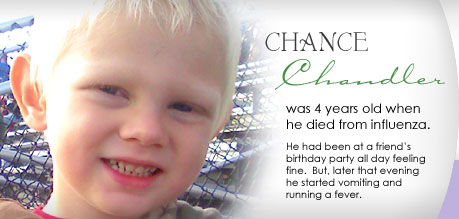
Tell anyone who says this to you to read Jen Lastinger’s story. Or the Chandler Family, whose four-year-old son, Chance, died. The Crafts, who lost their beautiful fifteen-year-old daughter Chelsea.  The Marottas, whose five-year-old son, Joseph, died from flu. The Lins. The Smiths. The McGowans. The Steins. The list at Families Fighting Flu goes on. And each one of these families is a family like yours. The loss was unimaginable. It is a slap in the face to any parent who has lost a child to flu to hear that disease described as “not that bad” or not worth vaccinating against. To me, as a parent, it’s these stories—stories these parents are willing to live through again and again as they advocate for flu awareness and vaccination—that get me in my car and to the doctor’s office for my shot and my children’s shots. If we are willing to entertain the decision whether or not to vaccinate our children against flu, we also must be willing to learn about these children. Otherwise we come by a decision not to vaccinate dishonestly.

Myth: the flu vaccine isn’t safe/its safety hasn’t been proven/it needs more testing

Given in the millions upon millions of doses around the world, the flu vaccine is among the most successful and safe vaccines ever devised. Dr. William Shafner, Chair of Preventive Medicine at Vanderbilt and President of National Foundation of Infectious Diseases tell us that the CDC, along with its sister public health organizations across the world, monitor the flu vaccine constantly. And although the FDA licenses a new variant of the vaccine every year, each vaccine comes to us with the basic structure of the vaccine that has that extraordinarily safe record. It honestly doesn't get any safer than this vaccine.

Myth: You can get the flu from the shot

This one’s easy. Nope. Not possible. There’s a chance you may feel achy and sneezy, but that’s not flu. It’s the immune response kicking in. It means your existing immune system wasn't up to snuff and it is now kicking into high gear. It means it is working.

At the end of the day, the decision comes down to whether you think your life is worth the flu shot. I know Emily Lastinger's was. I know Chelsea Oliver (Craft)'s was. I know Chance Chandler's was. I know every single child who has died from influenza's life was worth getting the flu vaccine, and it's a tragedy that in so many of these cases, circumstances prevented them from getting the vaccine. Whether it was outdated immunization guidelines, a snowstorm, a lack of vaccine at the clinic, or misunderstanding about the fact that you need to be vaccinated each year, the bottom line is that chances are these children would be here today if they had been vaccinated. And that's why their families fight, and will continue to fight every day of their lives, to make sure you never have to suffer like they did. It's your decision.

A special note to pregnant women: it is critical that you get your flu vaccine this season. You are as vulnerable to serious complications from flu as are the elderly. More, if you immunize, you pass on some of that protection to your baby, who will come into this world absolutely helpless against the flu. And with more and more people choosing not to protect themselves (and the community) against flu, you need to do all you can to keep that baby safe.